My blog has moved! Redirecting…

You should be automatically redirected. If not, visit www.gangles.ca and update your bookmarks.

The Quixotic Engineer

Wednesday, December 5, 2007

The Golden Compass

There have been very few mainstream film releases this year that I've had any interest in. I think that the last movie I actually saw in the theatres was the brilliant Hot Fuzz. There is, however, one film coming out before the end of the year that I've been eagerly anticipating for quite some time now.
The Golden Compass

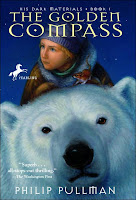
In my last year of high school, I read Philip Pullman's The Golden Compass, the first in the His Dark Materials trilogy. I was instantly fascinated by Lyra's world; its strange combination of steampunk, science, magic and religion was unlike anything I had ever imagined. Her parallel universe had its own language derived in part from archaic words: Oil became Naphtha, Greenlanders became Skraelings and electricity became anbaric power. I have read the series many times since then, and Pullman's imagination never ceases to astound me.

When I first heard about the film adaption of The Golden Compass, which is arriving in theatres this weekend, I was cautiously optimistic. The thought of Jordan College being filled with Hollywood actors tempered my excitement. If the movie version of my favorite book, The Hitchhiker's Guide to the Galaxy, has taught me anything, it's that sometimes an adaptation ends up being nothing like the vision of the story that you had built up in your head.

That being said, after watching the first five minutes of the film courtesy of the Internet, it seems like they did a great job with the visuals. The little girl playing Lyra seemed appropriately spunky as well. However, the rapid-fire explanation of Dust, Daemons, and Panserbjørne was extremely disappointing. The best part of The Golden Compass was being gradually introduced to the strange things in Lyra's world, and listing them off right from the start spoils the mystery. It's also evident from the trailer that the religious tone of the books has been severely diluted. Instead of the bad guys being the alternate universe Catholic Church, they've created a quasi-fascist organization to pit against Lyra and her friends. I question how they're going to deal with intercision and puberty without the religious slant.

I'm sad to say that even if the movie is junk, they'll be taking my money anyways. Even if they do ruin it, at least I'll always have the books!

Labels: ,

Tuesday, November 13, 2007

Memento and External Memory

Memento

It had been in my movie backlog for ages, but I finally got around to seeing Memento this weekend (and absolutely loved it.) It's nearly a decade old, but here's a brief spoiler-free synopsis for the uninitiated: it's a story told chronologically backwards about Leonard Shelby, a man with short-term memory loss trying to avenge his murdered wife. To remember who people are, where he lives and what he's doing, he consults relevant notes and pictures in his pockets at all times, keeping the most vital information tattooed on his body.

While the character's handicap was extreme, I felt a strong empathy with his condition. I'm a forgetful person by nature and, like Leonard, am constantly relying on external memory to function. Text files, post-it notes, e-mails and address books have become my substitute for real memory. I hardly take the time to remember anything nowadays; birthdays, telephone numbers, assignment due dates and addresses are taking up less and less of my cerebral real estate.

It doesn't stop there; I am now reliant on the internet for information. I've hit ten Google searches and half a dozen Wikipedia articles in my twenty minutes of writing so far. My daily hits on both sites likely number in the hundreds, and twice as many when I'm programming. Having a wealth of information at your fingertips is a major boon, but my work is now dependant on it (as referenced by a recent xkcd strip.) When the internet goes down, I cringe at the idea of stooping to consulting the phone book, a real map, or my 40 year old Encyclopedia set.

While it's true that our grandparents' generation could dial a friend, get directions and long divide using brain power alone, is the relegation of our long term information storage and computation power to machines necessarily a bad thing? NY Times columnist David Brooks argues "no" in a recent article entitled "The Outsourced Brain."

Until that moment, I had thought that the magic of the information age was that it allowed us to know more, but then I realized the magic of the information age is that it allows us to know less. It provides us with external cognitive servants — silicon memory systems, collaborative online filters, consumer preference algorithms and networked knowledge. We can burden these servants and liberate ourselves.

What do you think? How do you use computers and the internet as a brain-extension in your daily lives? Is "outsourcing" our brain power helpful, harmful, or inevitable?

Labels: , ,

Friday, July 20, 2007

Children of Men

TV Reporter: The world was stunned today by the death of Diego Ricardo, the youngest person on the planet. [...] He was 18 years, 4 months, 20 days, 16 hours, and 8 minutes old.

Children of Men

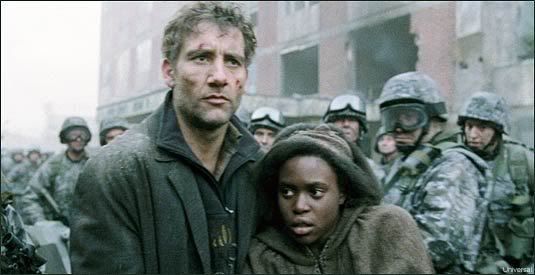
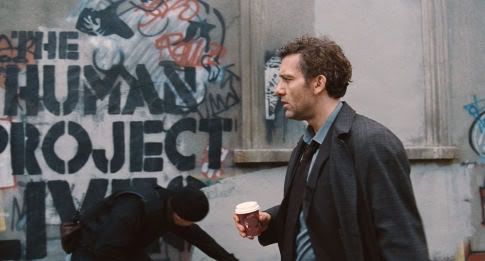
I've always had a fascination with narratives set in a dystopian future (see 1984, Brazil, Brave New World, Blade Runner, even Half-Life 2). The good ones evoke a convincing world that could conceivably represent our own future. The great ones use this world to explore philosophical and moral issues. What struck me as unique about the film Children of Men, however, was how it presented a world rocked by an extension of our own contemporary Western issues: divisive immigration policies, xenophobia, terrorism, and overzealous homeland security. This picture of the world looks and feels real; it is by far the most convincing vision of the future I have ever seen.

The world of 2027 is on the brink of ruin; two decade of inexplicable human infertility have led to widespread societal collapse. The film is set in Britain, where the anti-immigrant sentiment has been pushed to the extreme. The oppressive government ships thousands of illegal immigrants to sprawling refugee camps, with imagery and brutality that echo the Holocaust.

Children of Men

The plot follows Theo Faron (Clive Owen), an activist turned bureaucrat, who, due to a string of complex events, becomes the guardian of what may be mankind's only hope for survival: a miraculously pregnant woman named Kee. While the plot is excellent, it's the imagery, setting and cinematography that are the real stars of this film. Very little is explicitly stated; it's the visuals, such as a country field filled with the burning corpses of livestock, that tell the story of society's collapse. Many scenes are done with a single unbroken wide shot, which allows the viewer to take in the richness of the landscape.

Children of Men is quite simply a remarkably good movie, and I would recommend it without reserve to anyone. Whether it's the bleak landscape, the tremendous visuals or the touching characters and dialogue, everyone will be able to find a part of this film that affects them in a very profound and meaningful way.

Labels: ,